Polski
  English
  Português
  Español
  Français
  Deutsch
  Türkçe
  Magyar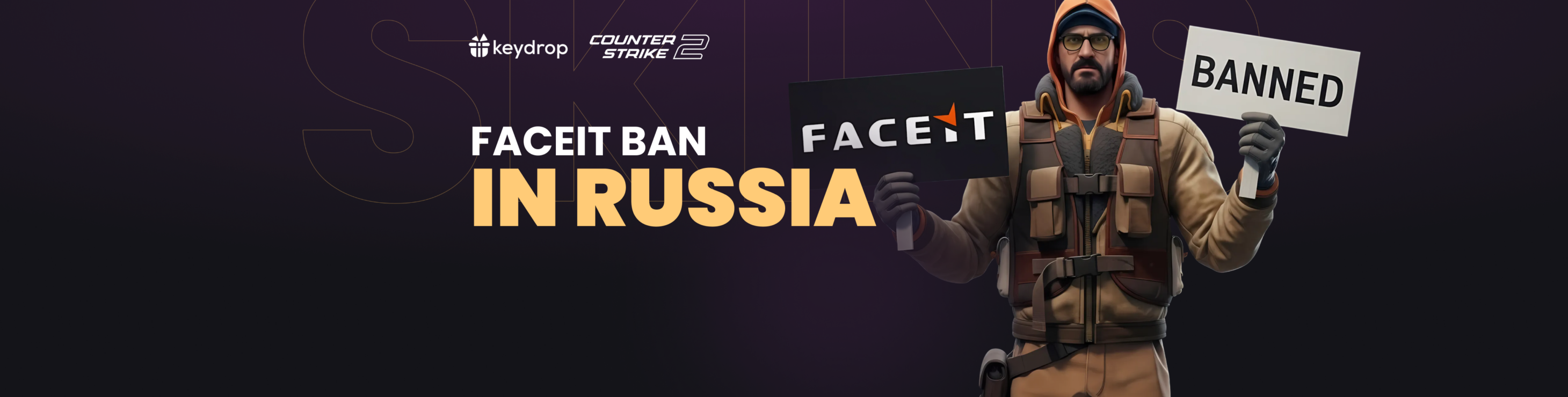

Russian players have been blocked from accessing FACEIT, creating significant disruption in the Counter-Strike ecosystem. Earlier in 2025, rumors about FACEIT being banned in Russia were quickly confirmed by prominent Russian streamers and community members. According to reports from the ground, Russian players can no longer access the FACEIT website without a VPN, marking a significant shift in how the competitive CS2 community operates in the region.
The situation became real when popular Russian streamer King Hikes confirmed the block, stating that FACEIT is indeed inaccessible within Russia’s borders. However, the technical reality is more nuanced than a complete shutdown. The Russian government has blocked the FACEIT website itself, not the game servers—a crucial distinction that affects how players can still participate.

How does the FACEIT Ban in Russia Actually Work?
The FACEIT ban in Russia doesn’t mean players are completely locked out of competitive play. Instead, it’s a website-level block that requires a workaround. Russian players can still access FACEIT matches, but the process involves an extra step that most of the community has already adapted to.
According to King Hikes and other Russian community members, the VPN requirement only applies to accessing the FACEIT website itself. The actual gameplay doesn’t require a VPN connection, which is a critical detail that many initially misunderstood. The process is straightforward: turn on the VPN, log into FACEIT, retrieve the server IP address, connect to the server, turn off the VPN, and then play normally. This means that in most cases, latency and ping remain completely unaffected—a relief for players worried about their competitive performance.
The underlying cause appears to be Russia’s recent restrictions on Cloudflare nodes, which FACEIT relies on for website hosting and content delivery. This isn’t a direct FACEIT ban by the Russian government, but rather a collateral effect of broader internet infrastructure changes. FACEIT has reportedly encouraged affected users to contact their ISPs for clarification, suggesting the platform itself is working to understand and potentially resolve the situation.

What This Means for the CS2 Community
While Russian players have found workarounds, the real concern lies in what this represents for the future. A user on a Russian forum claimed that the state Duma has announced plans to block all websites linked to the US and Europe, which could signal a much larger wave of restrictions coming to Russian internet infrastructure. If this escalates, FACEIT could be just the first in a series of blocks affecting Western gaming services.
If Russian players are gradually pushed off FACEIT, they’ll be forced to migrate to alternative platforms or regional servers. This creates several cascading problems: language barriers, reduced match quality, increased frustration, and potentially more cheaters being funneled into the same competitive queues. The competitive integrity of CS2 in Russia could suffer significantly.
But here’s where the implications become critical for the global CS2 community. Russian players represent a massive portion of the skin trading and investment ecosystem. We’re talking about dedicated collectors, active traders, case openers, and high-volume players who move enormous amounts of inventory on third-party markets. These aren’t casual players; they’re core participants in the CS2 economy.

The Economic Impact on the CS2 Skin Market
If Russian players lose access to FACEIT and other Western CS2 services, the ripple effects on the skin market would be immediate and severe. Russian traders are responsible for a significant portion of liquidity in the mid-tier and high-end skin markets. When a region that large gets partially or fully cut off, the effects don’t stay local—they spread across the entire CS2 economy.
Less access to FACEIT and Western platforms means fewer active Russian traders. Fewer traders directly translates to reduced demand for skins. When demand drops, prices become unstable, especially for mid-tier and high-end items that rely on consistent trading volume. Beyond price volatility, players forced to rely on VPNs or alternative platforms face additional complications: account restrictions, payment processing issues, and overall uncertainty about their ability to trade and invest.
The CS2 skin market thrives on confidence and liquidity. When uncertainty creeps in, players stop buying, stop investing, and start panic selling. This creates a downward spiral that affects not just Russian players, but collectors and investors worldwide who depend on a healthy, active market.
Consider the current state of premium skins and rare collections. Much of their value depends on a robust secondary market with plenty of active buyers and sellers. If Russian players—who represent a disproportionate share of high-value trades—are sidelined, the market loses crucial liquidity. Prices for rare items could become more volatile, and the overall ecosystem becomes more fragile.
The Competitive Scene at Risk
The competitive implications are equally serious. FACEIT is the premier platform for serious CS2 players in Russia, offering anti-cheat protection, skill-based matchmaking, and competitive integrity that casual matchmaking simply doesn’t provide. If Russian players are forced to migrate to Valve’s matchmaking or other regional platforms, the quality of matches deteriorates across the board.
This creates a brain drain from FACEIT’s ecosystem. The platform loses active, skilled players who would otherwise contribute to a healthy competitive environment. Meanwhile, other platforms get flooded with displaced players, potentially overwhelming their anti-cheat systems and matchmaking infrastructure. The result is a less competitive experience for everyone involved.
Additionally, if routing to FACEIT servers themselves gets blocked—not just the website—the situation becomes catastrophic. At that point, VPN workarounds won’t help because the actual game servers would be inaccessible. This is the scenario everyone is watching for, as it would represent a complete shutdown rather than just a website block.

Internet Restrictions in Russia
The FACEIT ban in Russia doesn’t exist in isolation. It’s part of a larger pattern of Russian internet restrictions targeting Western services. YouTube, Twitch, Instagram, Facebook, X, and even Roblox are already blocked within Russia. However, most Russian internet users have adapted by using VPNs, which work effectively for these services.
The difference with gaming platforms is more nuanced. While social media and video platforms can function perfectly fine through a VPN, gaming services require low latency and stable connections. VPN usage can introduce unpredictability, though as mentioned, FACEIT’s workaround—using a VPN only for website access—minimizes this issue.
The real question is whether Russia will escalate beyond website blocks to actual server routing restrictions. If the government blocks traffic to FACEIT’s servers directly, no VPN workaround will help. This would be a complete shutdown, not just an access restriction. At that point, Russian players would have no choice but to abandon FACEIT entirely.
What Russian Players Can Do To Bypass This
For Russian players still wanting to compete on FACEIT, the current situation is manageable. Using a reliable VPN to access the FACEIT website, getting the server IP, and then disconnecting the VPN before playing is a proven workaround that preserves competitive performance. Many Russian players have already adopted this method without issues.
However, this is a temporary solution. If restrictions escalate to server-level blocks, this workaround becomes useless. Russian players should be prepared for potential migration to alternative platforms, whether that’s Valve’s competitive matchmaking, regional servers, or other third-party platforms.
The key is staying informed. Follow updates from FACEIT, monitor announcements from Russian ISPs, and keep an eye on community forums where Russian players share real-time information about access issues and workarounds.
FAQ
Is FACEIT completely banned in Russia?
No, FACEIT is not completely banned. The Russian government has blocked access to the FACEIT website, but the game servers themselves remain accessible. Players can use a VPN to access the website, retrieve server information, and then play normally without a VPN.
Will using a VPN to access FACEIT ruin my ping?
Not necessarily. Since you only need a VPN to access the FACEIT website and not to actually play the matches, your ping should remain normal during gameplay. You turn off the VPN after getting the server IP, so your connection to the game server is direct and unaffected.
Why did Russia ban FACEIT?
The ban appears to be a collateral effect of Russia’s restrictions on Cloudflare nodes rather than a direct FACEIT ban. FACEIT relies on Cloudflare for website hosting and content delivery. The Russian government has been blocking various Western services, and FACEIT got caught in these broader restrictions.
Could this affect the CS2 skin market?
Yes, potentially. Russian players make up a significant portion of the CS2 skin trading ecosystem. If access to FACEIT and other Western platforms becomes more restricted, it could reduce trading volume, decrease demand for skins, and create market volatility, especially for mid-tier and high-end items.
What happens if Russia blocks FACEIT servers, not just the website?
If server-level routing gets blocked, the situation becomes much more serious. VPN workarounds wouldn’t help because the actual game servers would be inaccessible. This would force Russian players to migrate to other platforms entirely.
Are other gaming platforms at risk of similar bans?
Potentially. According to reports from Russian forums, the state Duma has announced plans to block all websites linked to the US and Europe. This suggests FACEIT could be just the first in a series of restrictions affecting Western gaming services.
Can Russian players use alternative platforms instead of FACEIT?
Yes, but with trade-offs. Valve’s competitive matchmaking is available, but it lacks FACEIT’s anti-cheat protection and skill-based features. Other third-party platforms exist, but they may have different communities, matchmaking quality, and server locations.
How long will this FACEIT ban last?
It’s unclear. The situation depends on Russian government policy and Cloudflare’s ability to maintain infrastructure in the region. FACEIT has urged affected users to contact ISPs for clarification, suggesting this could be resolved if infrastructure issues are addressed.